


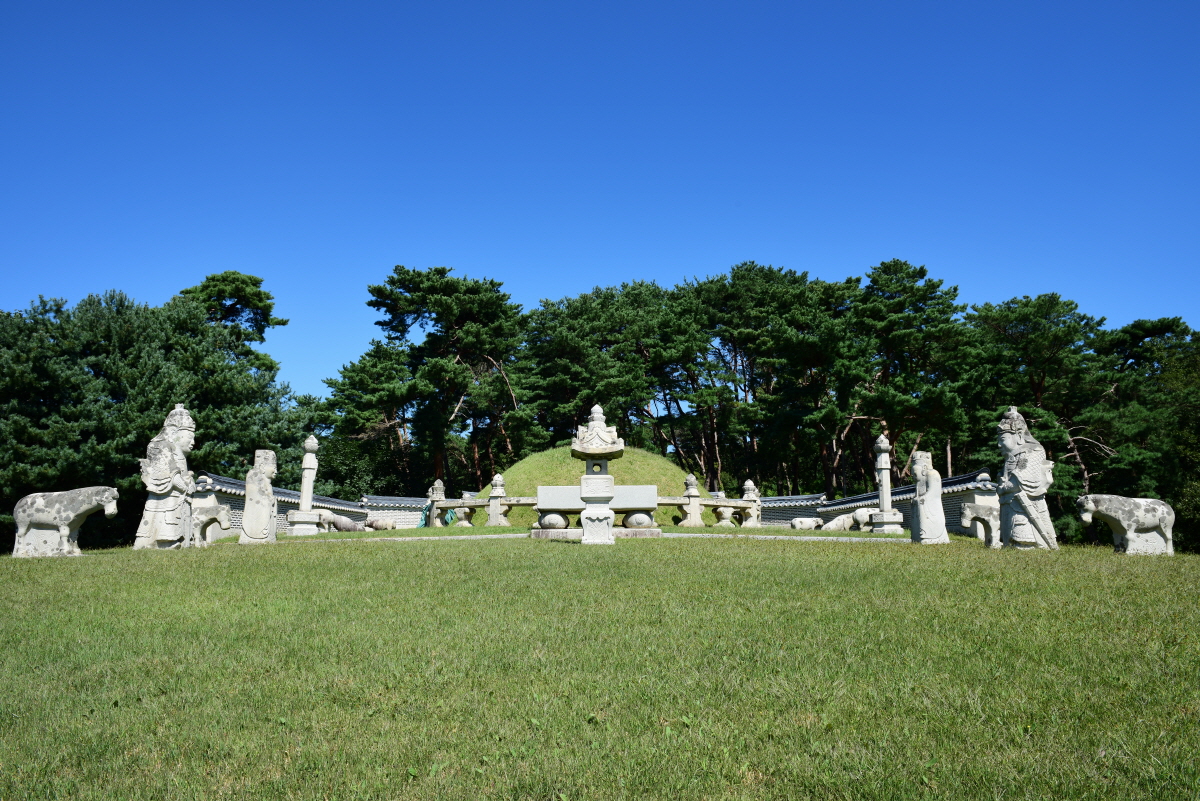
Crown Prince Hyomyeong and His Consort, Queen Sinjeong
Sureung is the royal tomb of Crown Prince Hyomyeong and his consort. He was the eldest son of King Sunjo, the 23rd king of the dynasty, and his consort was posthumously titled Queen Sinjeong. Traditionally, husband and wife were buried under a single mound in the belief that such burial would help the couple continue the marital relationship even after death. And this tomb is a fine example for this tradition.
According to historical records, the prince was a devoted filial child and an ambitious young man full of reformative ideas. When he was eighteen, he started active participation in political affairs on behalf of his sick father and continued to make distinguished achievements in the political arena in the 19th century. For instance, he tried hard to restore royal sovereignty by counteracting the political influence of maternal relatives. He also maintained politically impartial stance in recruiting capable resources for the government.
Also, he was a talented man of letters and performing arts enthusiast. He wrote many poems and published essay collections. He even wrote lyrics for the musical works and choreographed dances performed in the court.
Unfortunately, the prince died at the age of twenty two before receiving the opportunity to be crowned. Accordingly, his tomb was built as that of a crown prince at first. His tomb was changed later to fit the status of a king, after his son was enthroned to be King Heonjong, the 24th king of the Joseon Dynasty.
Queen Sinjeong
Crown Prince Hyomyeong, the occupant of this royal tomb, died young before he was given an opportunity to be crowned. However, his consort relished a long, prosperous life, and she is generally referred to by her posthumous title Queen Sinjeong. History shows that she was a powerful charismatic figure and actively engaged herself in the state and royal household affairs until her death in 1890 at the age of eighty two.
After the prince died in 1830, an eight-year-old boy born between the prince and his consort was enthroned. The new king, Heonjong, honored his deceased father with a king’s title, and raised his mother’s royal status to a queen dowager. Sadly, King Heonjong died young, too, leaving no heir to succeed to the throne. It was eventually given to a minor royal who had been leading a poor farmer’s life. The farmer king died only fourteen years after he was crowned, again, leaving no heir. By then, Queen Sinjeong was in the status of the queen grandmother and the most senior member of the royal family. It meant that she had the right to appoint the heir to the crown.
After much consideration, she adopted the twelve-year-old son of a distant relative of the royal family, and crowned him into the 26th king of the dynasty. She expected the alliance with the boy king’s biological father to help her remove her political rivals and move ahead with various reform plans. In the following ten years, the two regents drove out corrupted officials and reformed the tax system. Also, they decided to abolish private Confucian academies because their political influence had been a lot of threats to royal sovereignty.
Crown Prince Hyomyeong’s untimely early death deprived him of the opportunity to be king and rule the country as he had planned. Ironically, however, the opportunity was given to his consort. While relishing a long life, she had a large influence in the history of Joseon during the late 19th century.
Donggureung: Sureung
@Registered by : KOREA TOURISM ORGANIZATION