


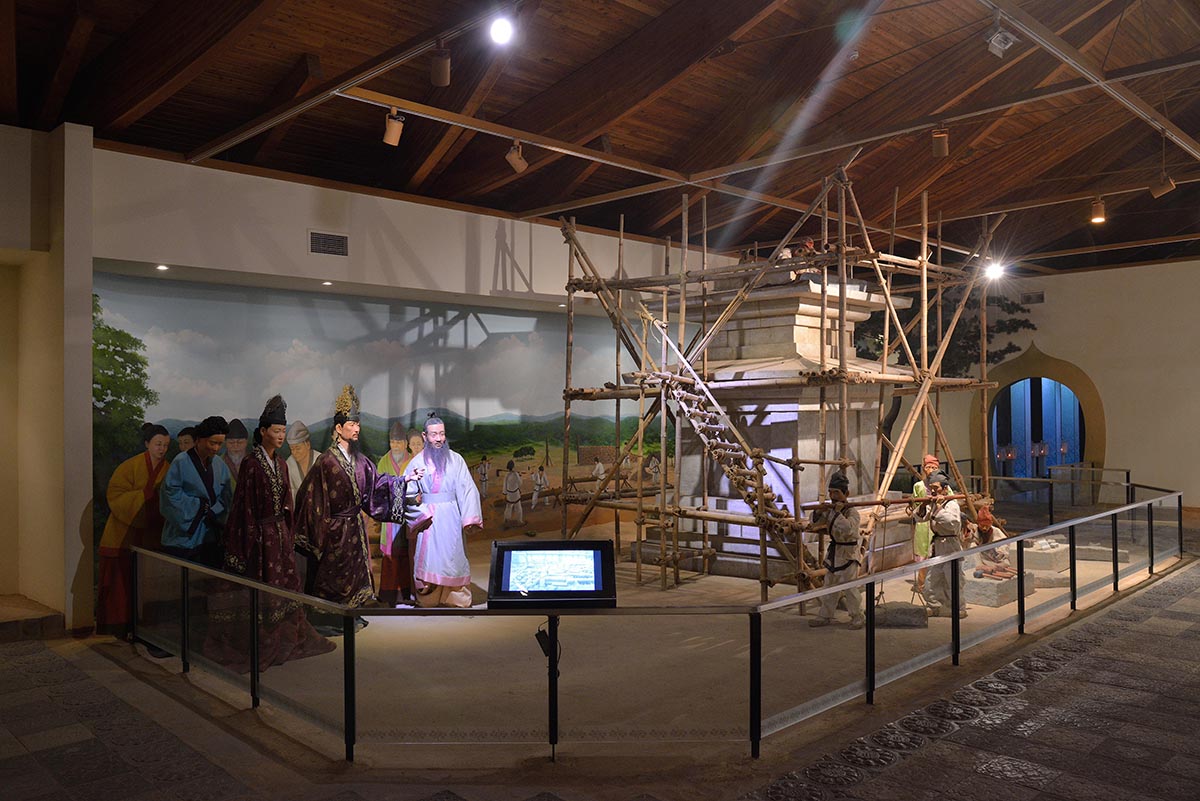
Baekje Pagoda
[Narration]
Many centuries ago, Buddha Sakyamuni achieved nirvana and later, when his body was cremated, eight sariras were found among the remains. The eight sariras were distributed to various different regions of India, and in each region a tower was built to enshrine them. This is the origin of the Buddhist pagoda structure.
In English, a Buddhist pagoda is often referred to as a stupa, but the word originates from the ancient Indian language known as Sanskrit. A stupa is defined as ‘a mound-like structure containing Buddhist relics, typically the sariras of Buddha’.
Wooden pagodas were popular in Baekje, but were superseded by stone pagodas in the 7th century. Unlike wooden pagodas, stone pagodas were resistant to fire, and the stone used to construct them, granite, was abundant in Baekje. This exhibition reproduces a typical scene from the site where the Five-story Stone Pagoda of Jeongnim Temple was constructed. Let’s listen to an interview with an artisan from Baekje and hear what he has to say. Hello there!
[Artisan]
Hello!
[Narration]
We’d like to know how the stone pagoda was built.
[Artisan]
Sure, ask me as many questions as you like.
[Narration]
If you make pagodas out of stone, they will lack the gentle softness of those made out of wood, right?
[Artisan]
Not really. The building material is the only point of difference. The stone pagodas were made in such a way as to retain the grace of the original wooden pagodas. Can you see the convex curve in the middle of the pillar? It is an architectural technique known as entasis and it was used frequently in ancient Greece. The columns of the Parthenon utilize the entasis effect, slightly tapering from the middle upward. The curvature of the eaves resembles the nose of a beautiful woman, don’t you think?
[Narration]
It really does. It’s amazing that such delicate curves were crafted from hard stone.
[Artisan]
The architectural design was the most important aspect of constructing each stone pagoda. The hard granite slabs were designed to fit each part of the pagoda. Based on a solid foundation, the stone pieces were neatly stacked from the bottom up to assemble the structure. This complicated process was necessary to transform the raw blocks of granite into a delicate, beautiful stone pagoda such as this.
[Narration]
Wow! I am impressed by the progressive architectural technology used by the artisans of Baekje. Good luck with finishing the construction and thank you for kindly explaining how it was done.
Jeongrimsaji Museum: Baekje Pagoda
@Registered by : KOREA TOURISM ORGANIZATION