


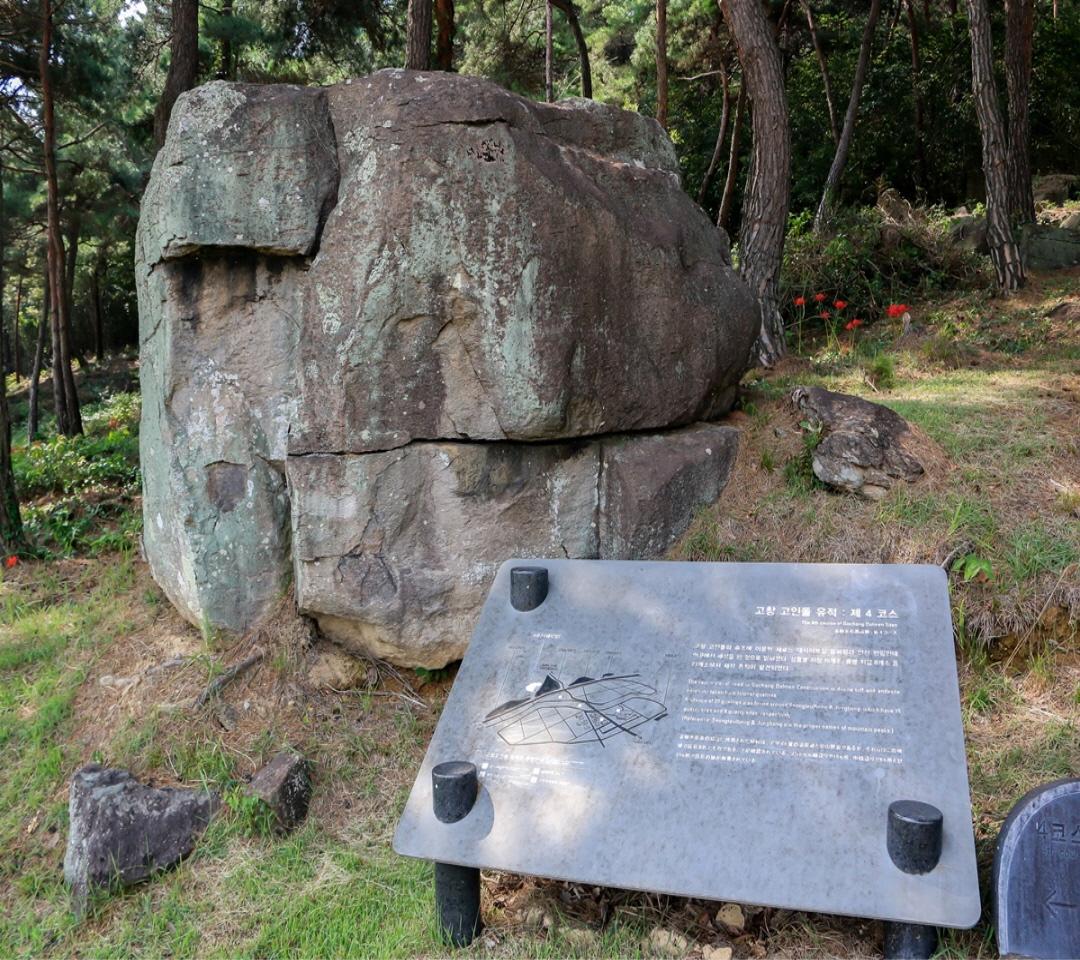
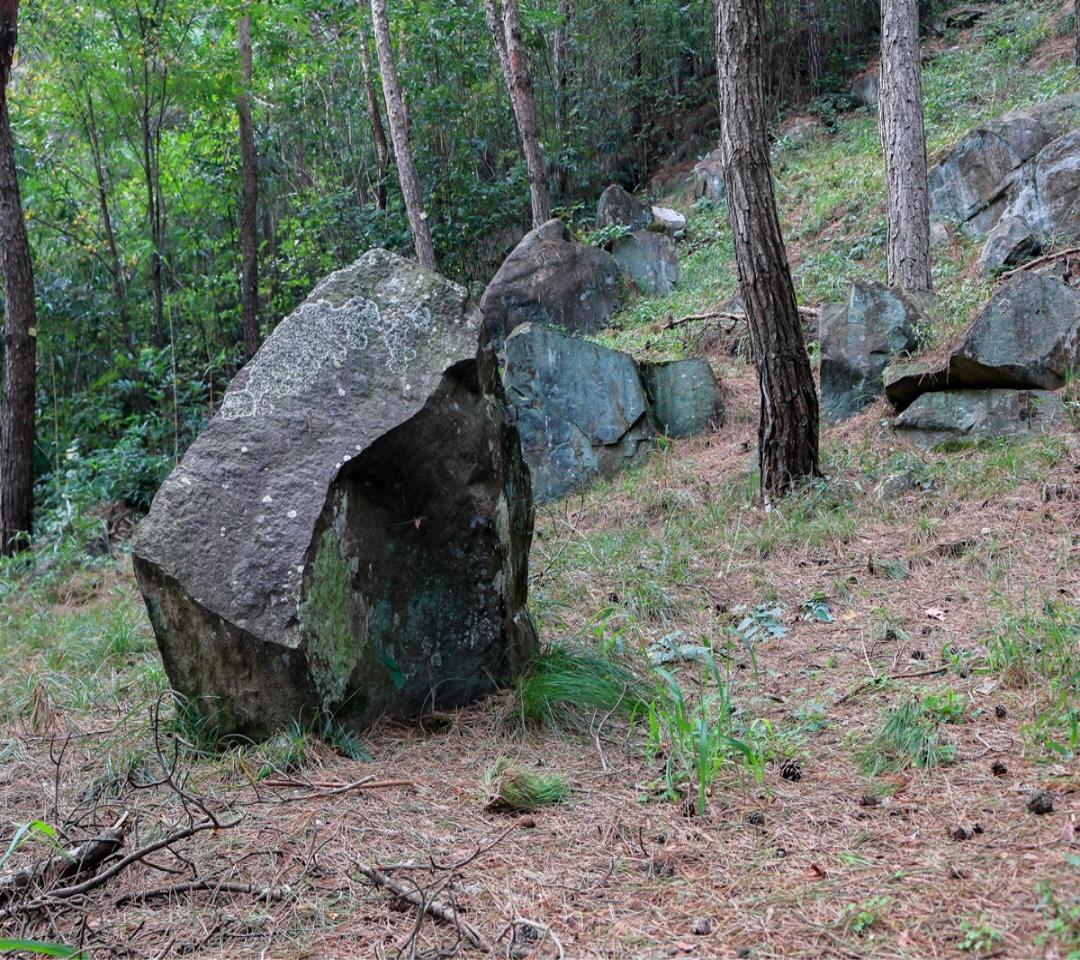
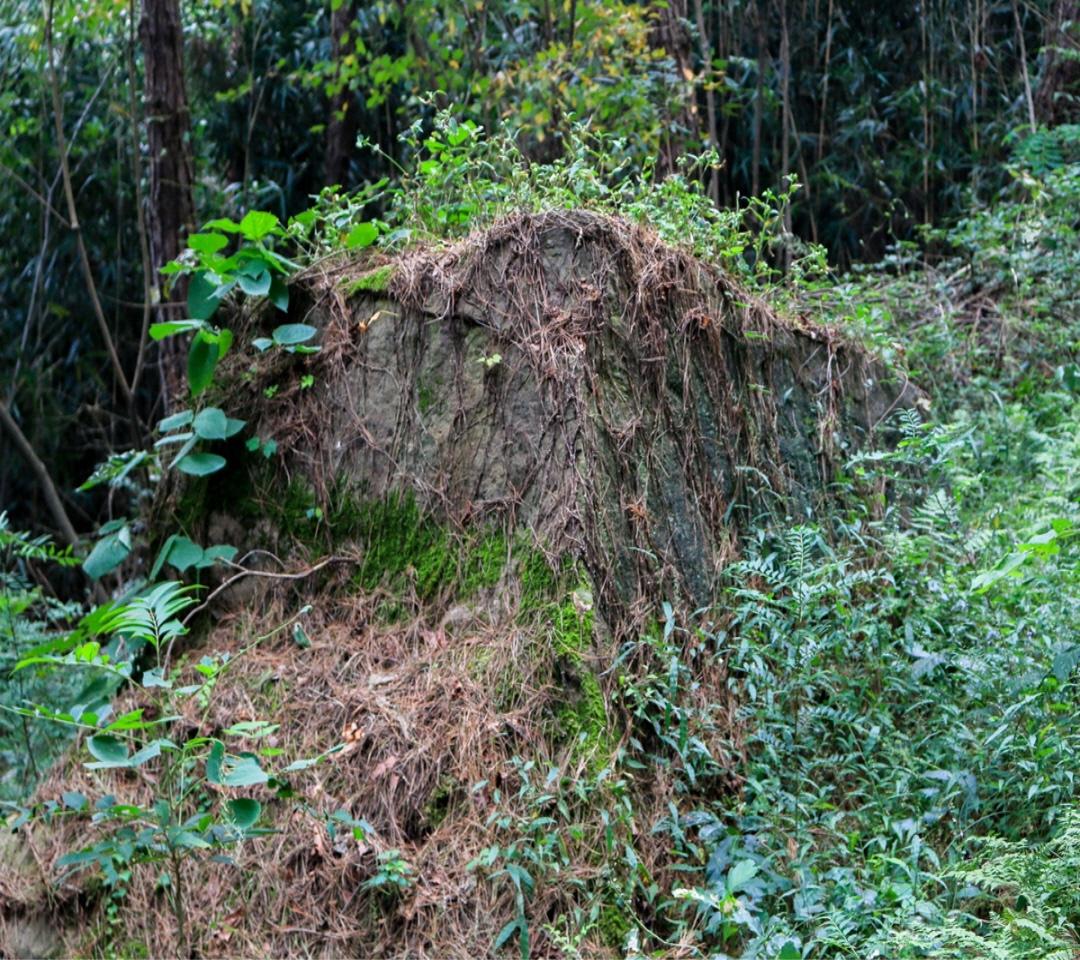
Gochang Dolmen Site Course 4
[Guide]
"This is the Gochang Dolmen Site Course 4, where a quarry is located."
[Tourist]
"A quarry? Do you need a quarry to build dolmens? Aren't you suppose to build one out of rocks that exist naturally?"
[Guide]
"The most important part of a dolmen is the capstone. There is also an example of a capstone being obtained from naturally existing rock. However, it was very difficult to find stones to be used for capstones from among natural rocks. That is why people mined stones from a quarry to build dolmens.
[Tourist]
"It's very interesting to know that people had stone-cutting techniques at that time. How did the people at that time remove the stone?"
[Guide]
"There were three or so ways to remove the stone. First, find a suitable stone and drill a small hole in it at intervals of 10 to 15 cm. The first method was to drive a wedge into the hole and continue to hammer it down, while the second method was to drive wood into the wedge hole then pour water into it to remove it using the tension of the wood. Third, pour water into the wedge hole and wait for the water to freeze. Once the water freezes and its volume increases, cracks are created in the stone."
[Tourist]
"The technology sounds amazing."
[Guide]
"That's right. Our ancestors were quite wise. It has been found that the main ingredients of the capstones for dolmens in Gochang match those in the quarry on course 4. What we can see from this is that most of the stones at the dolmen site in Gochang were quarried here."
[Man]
Traces of stones quarried were found in 23 places around Seongteulbong Peak and Jungbong Peak, the mountains behind where the dolmens are located. Fifteen sites were found around the summit of Seongteulbong Peak and eight around Jungbong Peak, and it has been shown that they are clustered mainly on the ridges, covering a wide range. You can find the quarry at the K point by following the sign to the north, which shows “To the quarry for dolmens” behind course 3. It is located between 80 and 85 meters above sea level.
[Woman]
The traces of stones falling from the rough stone are usually clearly displayed on the front, the V-shaped groove was made lengthwise on the joint plane of the rough stone, and a wedge was inserted into the point plane and its top was struck to remove it. There remain traces of wedge holes in the rough stone, and rocks that fell from the rough stone and rolled down remain in the surrounding area.
[Man]
The dolmen distribution on course 4 consists of the section covering the area from the western end of the triangular valley field on course 3 to Sanggap-ri. A total of 41 dolmens have been discovered, including 10 go-board dolmens, 26 pad-stone dolmens, and 5 dolmens of unknown styles at the foot of the mountain running from Seongteulbong Peak and on the flat ground.
[Woman]
Go-board dolmens, also known as foundation dolmens, have a burial chamber underground, and four to eight supporting stones are placed around it, with a large capstone placed on top of them. Their characteristic is their grand appearance as they are raised above the ground's surface.
[Man]
The pad-stone dolmens have a capstone placed right above the burial chamber built underground. The pad-stone dolmens that cover their burial chambers without any supporting stones are alternatively referred to as no-support, lid, or footstone dolmens. In this type, a stone burial chamber is almost always found, indicating that they were originally intended to serve as tombs. The capstone is thin in the north, but in the south it tends to be thicker.
10, Segye-ro, Wonju-si, Gangwon-do (PC) 26464
TEL : +82-33-738-3852
Copyright© Korea Tourism Organization. All Rights Reserved.