

Okcheon Confucian School
[Traveler]
On the way up to this Confucian school, the first thing you will see are the red doors. Red doors were built in dignified buildings such as palaces, lecture halls, and Confucian schools. To the right, there is a headstone inscribed with the words: “Get down from your horse and walk from here.” As the saying suggests, this place is very solemn and important.
Confucian schools were built by government offices to educate local residents and hold commemorative rites for great scholars during the Joseon Dynasty. In 1398, the king who founded the Joseon Dynasty built Okcheon Confucian school. It consists of an educational facility for students at its front and a shrine for commemorative rites at the back.
Now, are you at the entrance to the Confucian school? The big building you saw on the way up here was the lecture hall, where students used to learn. The building to the right, which stands opposite the lecture hall on the left of the entrance, is a shrine to Confucius of China and Korean scholars.
As a place of education and ritual, even the building’s location and position follow strict rules. Let’s look at the lecture hall first. The splendid roof with the ears pointing upwards is a traditional style of Joseon architecture designed to avoid rain with wide eaves. The wide floor was used to hold lectures, and the teachers dwelled in the two rooms. For heating, the traditional under floor heating system called ondol was used.
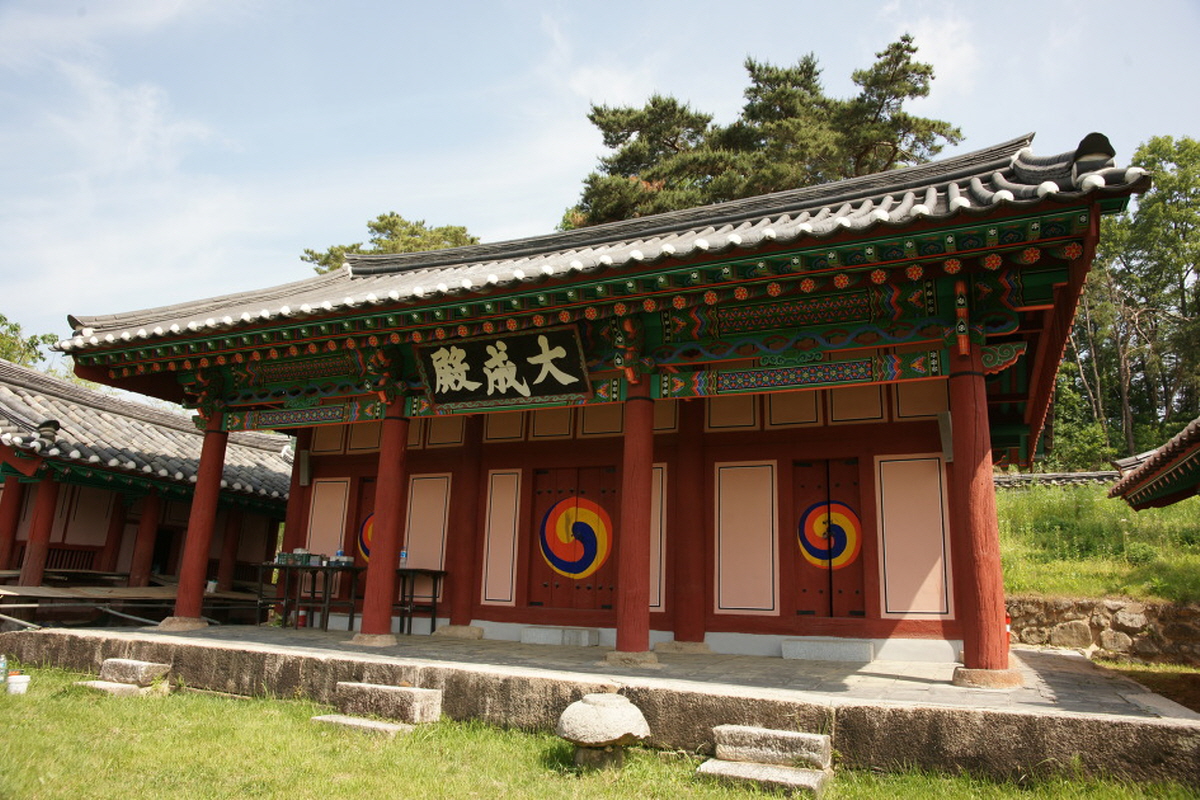
Now let’s look at the shrine across the lecture room. There’s a reason why the entrance consists of three doors. The middle door was built for deities, so ordinary people didn’t use it. It was customary to enter through the door on the right and exit through the one on the left.
The roof looks different from the one we saw before. It looks like a half-closed book hanging on the top. This type of Korean roof architecture has its own meaning. For buildings that emphasized tradition, such as shrines, a simple and humble roof was used, while for residential buildings such as schools and temples, more extravagant roofs were used.
During the Joseon Dynasty, Confucius’ teachings were selected by the elite as the national ideology, and the general way of life including customs, manners and traditions were formed within a Confucian framework. That’s why the ancestral tablets of Confucius, the founder of Confucianism, and those of four additional scholars are housed inside this shrine. It also houses the tablets of 18 people who contributed to the development of Korean Confucianism.
Finally, the humble building between the hall and the shrine is a dormitory for students. Originally, there were an east building and a west building, but only the latter remains now. The next course will take us to where Korea’s first lady used to live. We will see a traditional Korean house there. Shall we move on?
10, Segye-ro, Wonju-si, Gangwon-do (PC) 26464
TEL : +82-33-738-3852
Copyright© Korea Tourism Organization. All Rights Reserved.