


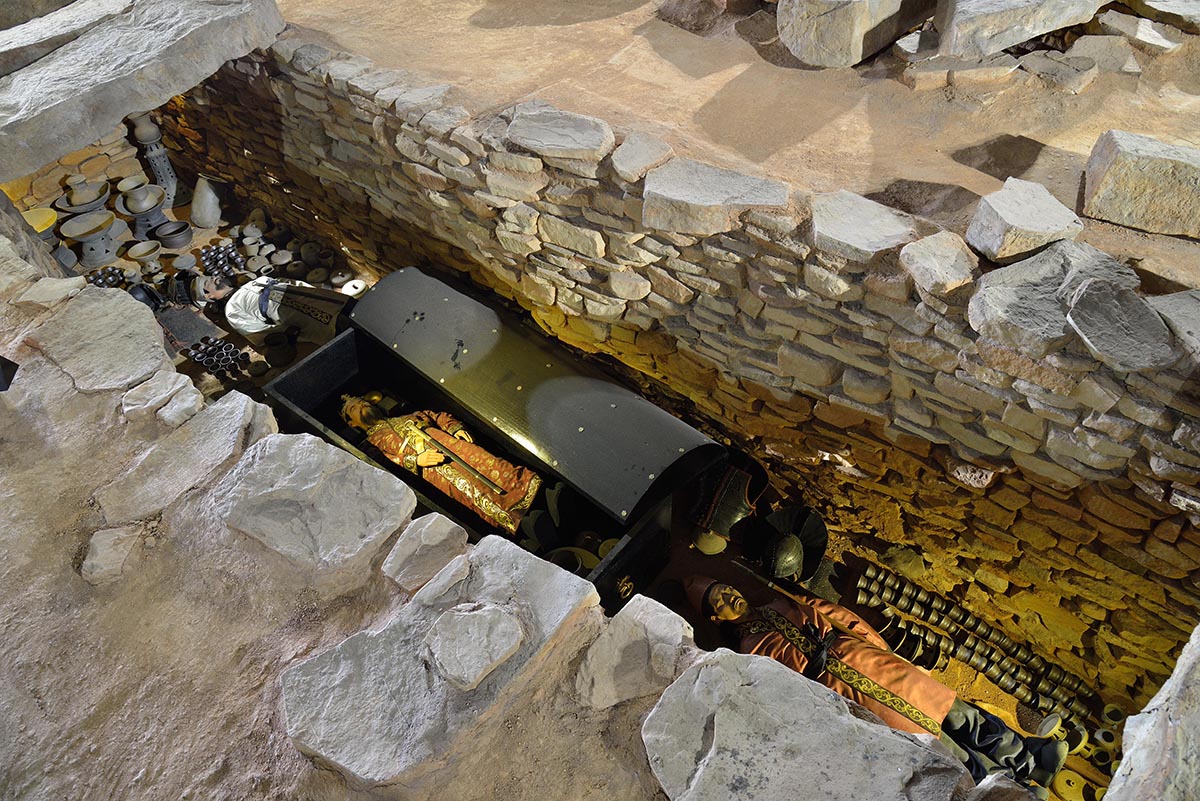
Custom of Sunjang, and People of the Tomb No. 44
Let’s talk about sunjang custom in detail. Among people who were buried in this tomb by sunjang, or sacrificial burial, some were women who were probably ladies in waiting, and some were men with large swords and bows who were probably warriors who used to guard their master.
In some skeletons, traces of injuries by sword or blunt weapon were found. According to this, we assume these people were killed forcefully rather than voluntarily to be buried together with the master of the tomb.
This custom shows us the ancient people’s view of the afterlife. Ancient people believed that after they die, their soul will not disappear. So they wanted the deceased to live the same lifestyle as when they were alive. That’s why people who used to serve their master were also buried together in one tomb.
Globally, ancient countries with this custom had a rigid caste system or patriarchal system. This ritual was mainly performed by early ancient civilizations such as Sumer, Egypt, and China, where absolute royal authority were established. In these societies, wives were buried together when their husbands died, and servants were buried together when their king died to show off the royal authority. Sunjang custom of Dae Gaya was also to stress its regal power.
However, this custom gradually disappeared as awareness on human rights increased. Instead, they made people and animal shaped statues with clay to put in the tomb along with the deceased. This custom was found in the tomb of Silla, a neighboring kingdom of Dae Gaya. The whole world was mesmerized when they found around 8,000 clay soldier statues near the Mausoleum of the First Qin Emperor, who unified China in 221 BC.
Daegaya Royal Tomb Pavilion: Exhibition Deck 2
@Registered by : KOREA TOURISM ORGANIZATION