


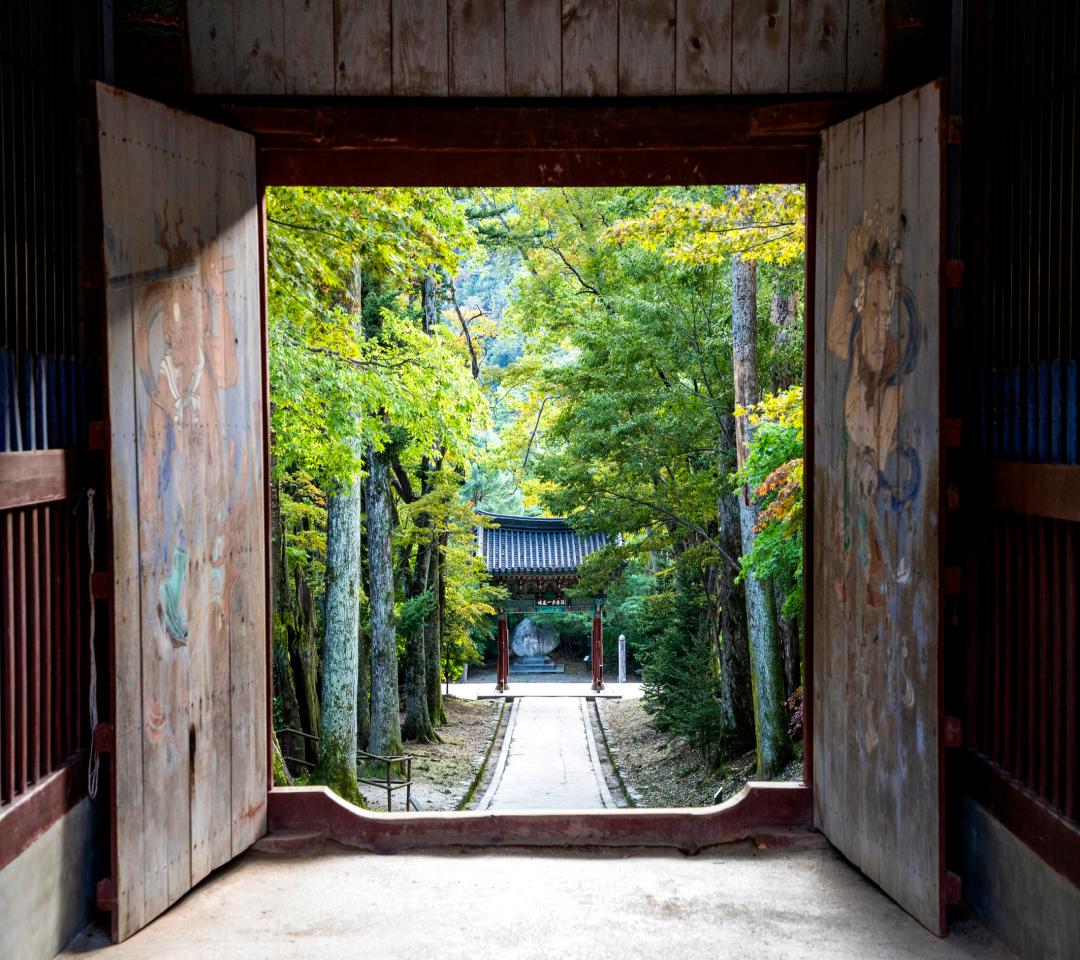
Move to the right side of Daejeokgwangjeon Hall. Visitors can find the mural paintings depicting the life of Buddha. On the back wall of the building, a series of murals narrates the founding story of Haeinsa Temple.
One painting portrays a lady lying in bed, haloed by two monks, one above and the other below her. The lady is the queen consort of King Aejang, who ruled Silla during the early 9th century. Crowned at the age of thirteen, the king greatly relied on his wife's care. Consequently, he was deeply distressed when she fell ill.
Despite the efforts of physicians and the best available medicines, her condition did not improve. King Aejang sought a sincere prayer for her recovery and dispatched messengers across the kingdom to find a noble monk who could fulfill his request.
One of the royal messengers encountered two monks engaged in deep prayer at the foot of a mountain now known as Gayasan. The messenger relayed the queen's illness and asked for guidance to aid her. One of the monks instructed him to return to the palace, tie a string around her wrist, and affix the other end to a pear tree located at the front of the palace.
Following the monk's instructions, the king saw a miraculous recovery in the queen as she rose from her bed. However, the pear tree, connected to her healing, withered and died. Deeply moved by this miracle, the king erected a temple in honor of the two monks at the site where they had prayed. Over time, the temple grew into the Haeinsa Temple we know today.
Murals of the Founders’ Tale (Daejeokgwangjeon Hall)
@Registered by : KOREA TOURISM ORGANIZATION