


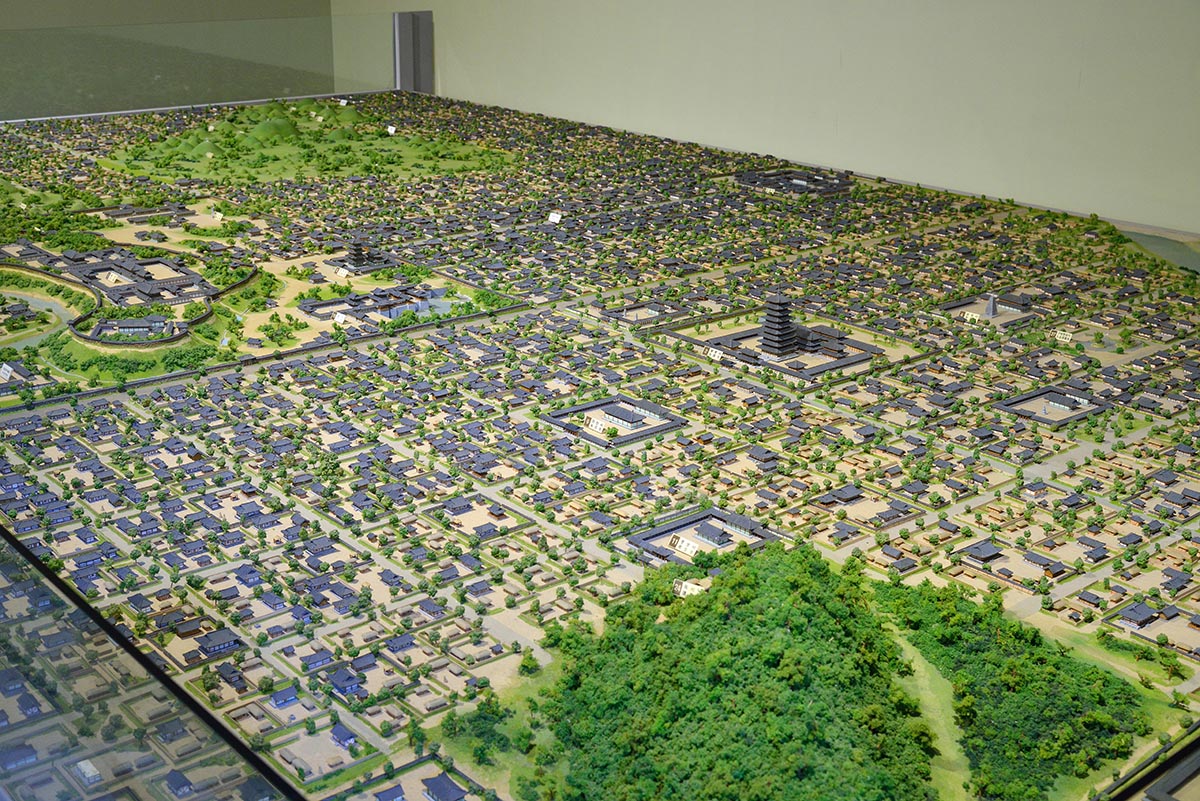
The Planned City of Seorabeol
[Narration]
Now, shall we look around Gyeongju as it was 1,300 years ago? Gyeongju, the capital of Silla, was a flourishing city and may have been comparable to the ancient cities of Constantinople, Baghdad and Chang’an. Well, what do you notice first?
[Visitor]
The houses look identical. They are all single-storied and have roofs of the same color.
[Narration]
Yes, you are right. All the houses have tiled roofs. During the Three Kingdoms Period, tile-roofed houses were built all over the Korean Peninsula. Did you notice that the houses are arranged in rows and form a grid pattern? This is because Gyeongju was a well-planned city. According to legend, the people of Gyeongju didn’t need an umbrella when it rained, as they were sheltered by the eaves of the houses. It was like walking under the arcades of Bologna.
[Visitor]
Where is the palace by the way? I can’t find it. The buildings all look so similar.
[Narration]
Do you see the crescent-shaped piece of land near the river? It is called Wolseong, meaning moon-shaped palace. Now, try to find the main street that runs from north to south. In China and Korea, it was common to have a wide road leading to the entrance of the palace. The biggest palace in Seoul, Gyeongbok Palace, also has a broad street leading to its main gate. Also, you can see there is a river to the south which functions as a natural moat.
[Visitor]
What is the towering building on the right? The palace consists only of single story buildings, but that one is as tall as the spire of a cathedral.
[Narration]
That building was also built by order of the king. It is the biggest temple of Silla and the top of the building is the temple’s pagoda. Buddhism was the national religion of Silla and many temples were built by royal command.
Silla History GalleryR4: Miniature of Gyeongju Downtown
Tag
@Registered by : KOREA TOURISM ORGANIZATION