


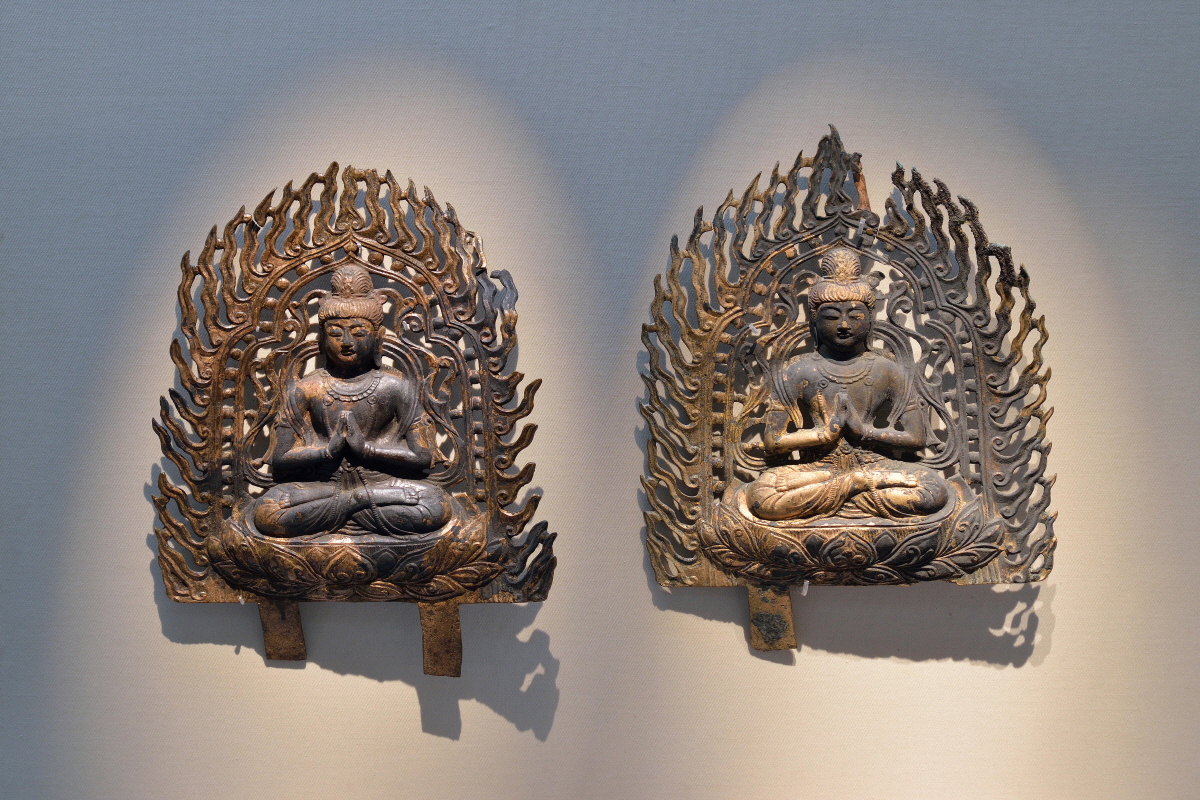
Buddha Triad Holding the Wishes of the Royal Family
These cast metal pieces are also statues of Buddha. The flat gilt-bronze pieces were made throughout East Asia. This one, from Anap Pond, has been praised for its artistic value.
The statues were delicately made. First, a wax mold was crafted and then covered with mud and dried. Then the mold was heated to melt and remove the wax, leaving a hard clay cast. Molten bronze was then poured into the cast. This complicated procedure produced sculptures of high quality, compared to the Japanese and Chinese method of hammering metal plates. You can see the details up close.
As you can see, many statues of Buddha were excavated from Anap Pond, but the one in the middle is the only complete piece among them. Its discovery implies that other Buddha triads would also have been made in a similarly delicate manner. The Buddha in the middle of the triad has a toned body and a solemn facial expression. The two disciples at Buddha’s sides are very attractive, twisting at the waist.
Why do you think these triads were found in the palace garden and not at a temple site? Just as Europeans had chapels inside palaces, the Silla palace had a Buddhist sanctum, and it is thought that the triads were decorative. Their function may have been to remind the royal family to pray for the peace of the nation.
Wolji Hall: Gilt-bronze Buddha Triad
@Registered by : KOREA TOURISM ORGANIZATION